



Healthcare runs on conversations. A prescription refill, an appointment reminder, a benefits question. Millions of these conversations happen every day, and the overwhelming majority are exactly what they appear to be: routine, administrative, and done in a few minutes.
But not all of them. A patient asking about a refill might mention they took the wrong dose. A routine reminder might surface a patient describing chest pain, or expressing thoughts of self-harm.
Today, the standard safeguard for that gap is a recorded message: if this is an emergency, hang up and dial 911. It puts the burden of triage on the person reaching out for help. Patients don’t always recognize when their symptoms have crossed into urgent territory (nor should they have to), and a recording can’t ask a follow-up question. The result is under-triage, which is when a patient is assigned a lower level of urgency than their condition actually warrants.
That’s the problem we built Clinical Escalations to solve.
What Clinical Escalations does
Clinical Escalations brings clinical expertise into AI agent conversations from the moment a conversation begins. It works as a background observer that runs alongside an AI agent, monitoring every conversational turn, maintaining a running picture of clinical risk as the conversation evolves, and continuously updating a structured triage signal. When that signal crosses a threshold, a configurable escalation layer fires the actions that our customers define: a warm transfer, a 911 prompt, placement in a nurse queue, or initiate a custom workflow.
The most important piece is that this happens regardless of why the patient is calling in the first place. A logistics conversation can be reclassified as an emergent clinical event the moment the patient says something that warrants it, such as mentioning they’ve been having chest pain for the last two hours. The administrative call becomes proactive, and a high-risk patient who otherwise might have slipped through the cracks gets the right attention at the right time.
Our goal is to miss no emergencies, the same expectation if a patient was talking to a live clinical team member.
Grounded in a clinical standard, not a black box
Clinical Escalations applies a continuous, turn-by-turn classification framework built on the industry-standard Schmitt-Thompson Call Prioritization Index (CPI), which is the primary phone queuing and prioritization protocol used by most nurse call centers across the country.
Every turn in the conversation receives a severity level (Level 1 through Level 5) aligned to the CPI, giving AI agents a transparent, medically validated foundation. The observer accumulates context as the call unfolds: risk assessed at turn five is informed by everything said at turns one through four. And because acuity in real-world triage only moves in one direction, once the system escalates to the highest level, it stays at the highest level.
Every turn produces a structured record: the assigned level, the system’s confidence, the key indicators it heard, and its reasoning are all logged for human review. Teams get a complete, auditable record of every escalation decision the system made and why.
Clinical Escalations is not a replacement for licensed triage nurses, but a support. It is a pre-assessment layer that ensures a clinically urgent presentation is never silently dropped inside an automated workflow.
Stress-tested before it ever reaches a patient
Before deployment, Clinical Escalations runs through a three-stage synthetic evaluation pipeline:
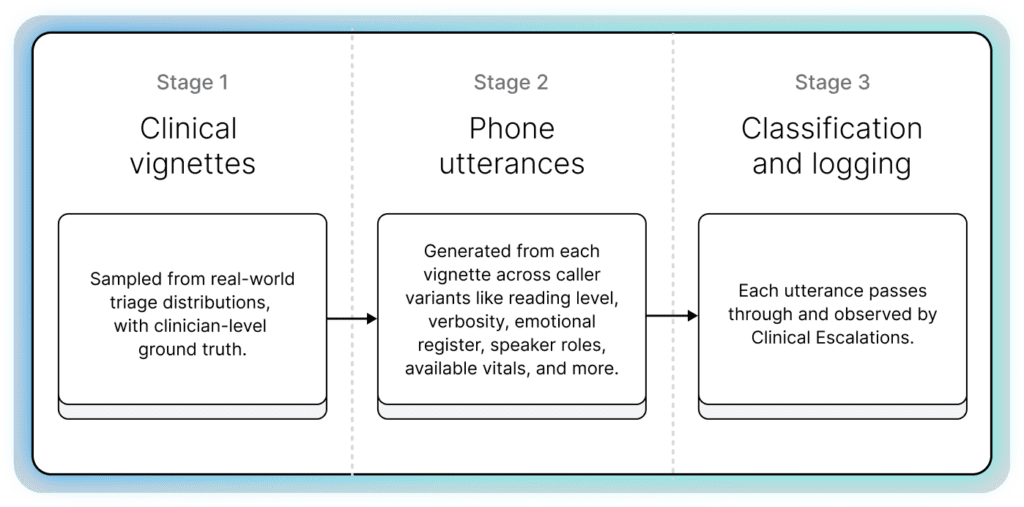
The system is held to explicit performance targets, including ≥95% recall on the most urgent cases and classification within two seconds of anything a patient says. All so that “good enough” is defined in advance, not after the fact, giving clinical teams what they need most: operational trust.
Why this matters for patients and for the teams serving them
In complex care settings, under-triage can lead to severe negative health consequences. Clinical Escalations prevents that risk. High-acuity presentations are caught and escalated in real time, with every decision logged: severity level, the clinical indicators the system identified, and its reasoning. No urgent need is ever silently dropped inside an automated workflow. In a recent implementation with a hybrid healthcare provider that delivers integrated primary, behavioral, and social care to low-income patients and individuals with complex medical needs, Clinical Escalations has captured 100% of emergencies without over-triaging.
“Healthcare isn’t linear. A patient calling for a prescription refill might actually be experiencing a clinical crisis,” said Erin Palm, MD, medical lead at Infinitus. “We built Clinical Escalations to ensure that no patient is ever stuck on hold when they should be talking to a nurse.”
For patients, Clinical Escalations means the burden of recognizing an emergency no longer rests entirely on them. No one is left on hold, or stuck repeating themselves while navigating an automated flow when they should be talking to a nurse. The right level of care arrives in real time, with fully briefed clinicians ready to help. What could have been a stressful, disorienting triage moment becomes one where the patient feels heard, understood, and met with exactly the right level of care.
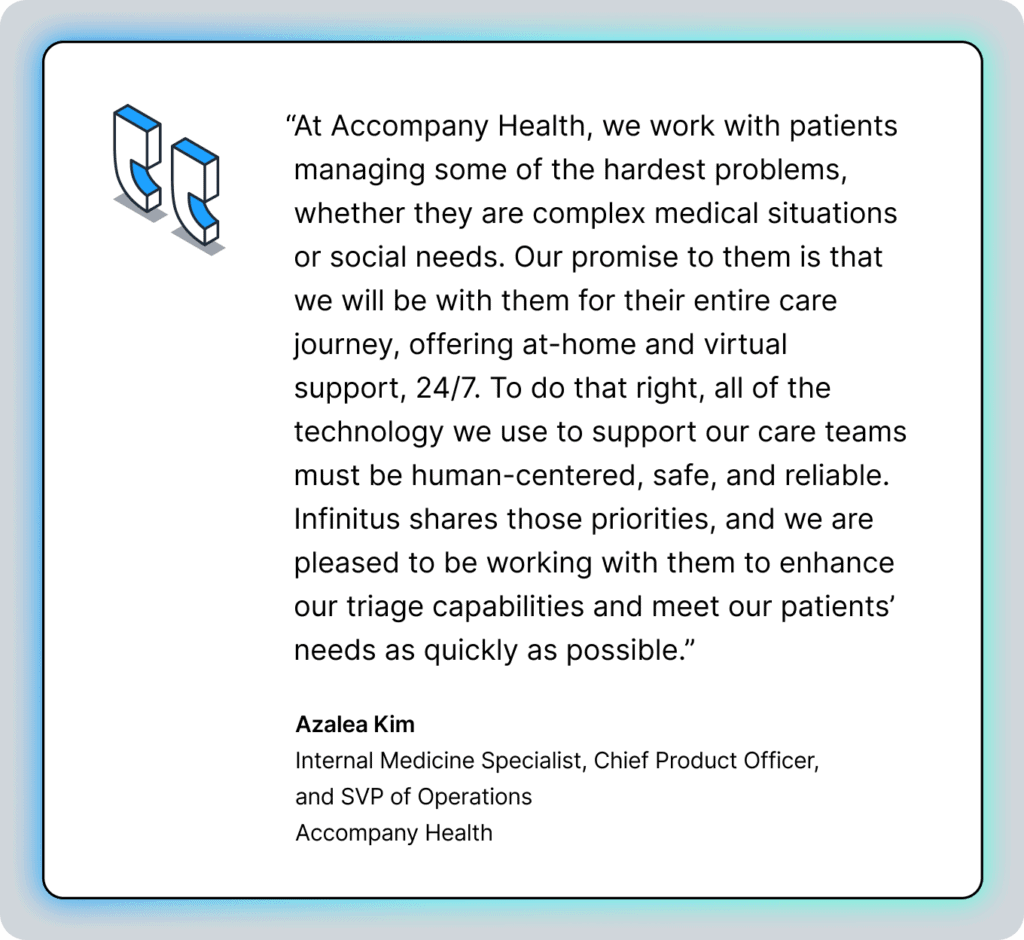
For healthcare organizations like provider groups, payors, and pharmaceutical patient support programs, it means clinical safety is built into every patient-facing call, not bolted on after something goes wrong. Every escalation is logged, auditable, and aligned to a recognized clinical standard, and the routing reflects your protocols. And no emergency is missed.
Clinical Escalations joins a growing platform for safer, more capable healthcare conversations, alongside Infinitus Studio, the first no-code AI agent builder for healthcare, and Lens, the conversation insights engine that evaluates every healthcare interaction across both AI agents and human teams.
If you’re ready to make sure no clinical signal goes undetected during any patient interaction, reach out to learn more about Clinical Escalations.