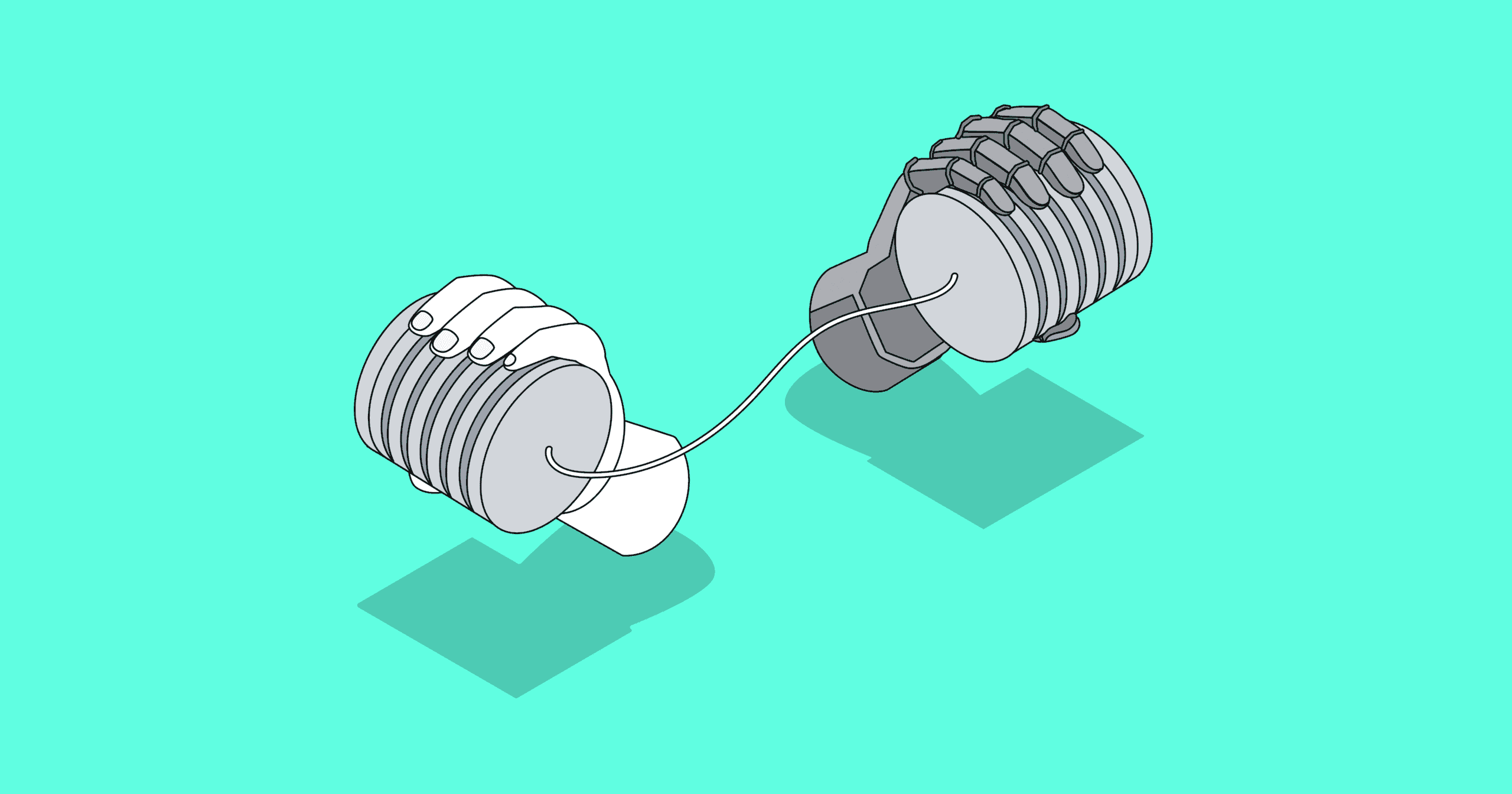

Healthcare runs on conversations. A patient describes symptoms to a nurse. A care coordinator tracks down an appointment. A clinician follows up on a gap in care. These exchanges are the connective tissue of the healthcare system – and they’re also where things most often break down.
At Infinitus, we’ve spent years building voice AI that works inside this communication landscape. Not as a single-purpose tool, but as a system capable of navigating the full range of clinical interactions, including with providers, with patients, and now, with whoever picks up the phone.
As we prepared to launch our inbound clinical triage agent (live now with Accompany Health), it’s worth stepping back to describe what we’ve built and why the progression matters.
Calling providers: The scheduling agent
Our appointment scheduling agent operates on behalf of care management teams, calling provider offices to book appointments for patients. The patient’s preferences – availability, location, provider type – are captured in advance through a partner mobile interface and handed to the agent before the call begins.
What sounds straightforward is, in reality, operationally complex. Provider offices vary enormously in how they handle incoming calls, what information they require, and how flexible they’re willing to be. The agent has to navigate hold times, front desk staff with different workflows, and the occasional curveball, like a scheduling system that’s down, a provider who’s no longer accepting new patients, or a referral requirement no one mentioned.
What this work taught us is that clinical AI in the real world has to be genuinely adaptive. Scripted interactions fail constantly. The ability to handle variation gracefully is foundational to any voice AI that operates at scale in healthcare.
Calling patients: The SDOH agent
Our social determinants of health (SDOH) agent works in the opposite direction, reaching out to patients on behalf of health plans and care teams to conduct structured screenings. SDOH conversations touch on some of the most sensitive dimensions of a person’s life – food security, housing, social support, transportation. Patients don’t always expect these questions, and they don’t always know why they’re being asked.
This work demands a different kind of sophistication. The agent has to establish trust quickly, explain its purpose clearly, and move through sensitive material in a way that feels respectful rather than clinical. It also has to know what to do when a response is unexpected – when a patient discloses something distressing, or when the conversation takes a turn the script didn’t anticipate.
What we built here was less about information collection and more about creating the conditions for honest conversation. That capability – holding space for what a patient actually has to say – turns out to be essential groundwork for everything that comes next.
Receiving patients: The inbound clinical triage agent
Our inbound clinical triage agent handles inbound calls and identifies which ones require urgent clinical attention. It is, in some ways, the most demanding application we’ve built, because the stakes of getting it wrong are highest, and because the inputs are the most unpredictable.
Patients calling in don’t announce their urgency. They describe symptoms in ordinary language, hedge, minimize, or don’t quite know how to characterize what they’re experiencing. Clinical urgency lives in the details of how people actually talk about their health; not in keywords, but in context. An AI that can only recognize “chest pain” when those words are spoken is not a triage system; it’s a search function.
What makes our approach different is the depth of clinical conversation experience we bring to this problem. The scheduling agent taught us to handle operational unpredictability. The SDOH agent taught us to hold space for sensitive, unexpected disclosures. Together, they’ve shaped an AI that can listen to what a patient is actually communicating, and make the right call about what happens next. (You can learn more about how our AI accomplishes this here.)
Why the progression matters
Each of these agents is valuable on its own. But the progression isn’t incidental. Building across all three directions of clinical communication – outbound to providers, outbound to patients, inbound from patients – has given us a uniquely comprehensive view of how voice AI performs in real healthcare contexts.
The lesson, consistently, is that clinical AI lives or dies on its ability to handle the unexpected. Healthcare conversations don’t follow scripts. Patients are anxious, confused, or sometimes just having a bad day. Providers are busy and not always accommodating. The system works because people adapt to each other in real time, and that’s exactly what we’ve built AI to do.
Triage is where that capability matters most. Because when a patient reaches out, there’s no room for delay, misinterpretation, or dropped context. The ability to listen, understand, and act in real time is foundational to delivering safe, effective care.
If you’re thinking about how to better handle inbound patient demand, identify clinical urgency earlier, or extend your team’s capacity without compromising quality, we’d love to talk. Reach out to learn more about how Infinitus inbound AI agents can support your organization.